

A community platform is software that lets creators, brands, and educators host memberships, discussions, courses, and events in one place. In 2026, the difference between Circle and Mighty Networks has widened significantly. Circle started in 2019 and has evolved into a workspace-style tool shipping 30+ new feature releases every quarter - including a website builder, ai agents, and a native desktop app. Mighty Networks began in 2017, founded by Gina Bianchini, and has leaned harder into its social-network model with native mobile apps, livestreaming, and member discovery tools. Choosing between them now means committing to infrastructure that shapes how your entire community grows.
There is no fake #1 here. This comparison breaks down what each platform actually does well, where they fall short, and who should pick which - based on real community needs, not abstract ratings.
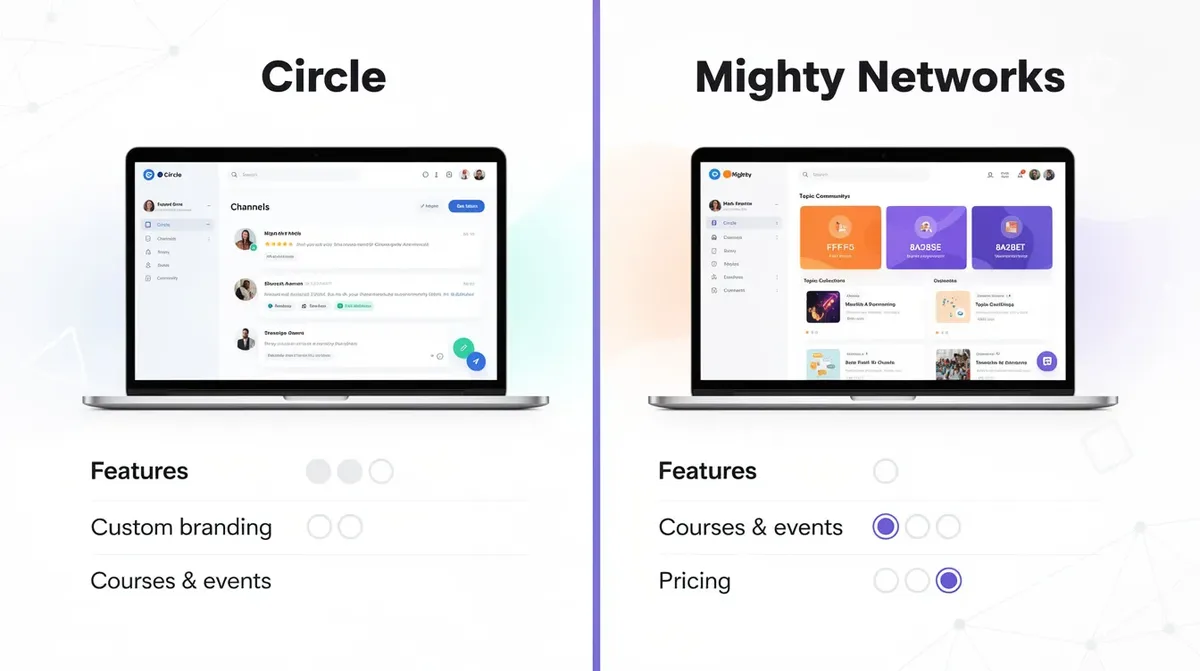
Circle vs Mighty Networks At a Glance
Category | Circle | Mighty Networks |
|---|---|---|
Best for | Professional communities, SaaS groups, structured discussions, automation | Branded mobile apps, live events, peer networking, course ecosystems |
Ease of use | Clean, Slack-like interface; fast setup | Comprehensive dashboard; steeper learning curve |
Key features | Community spaces, courses, workflow automation, gamification, website builder | Multi-feature spaces, native livestreaming, member directory, learning paths |
Pricing model | Tiered plans with transaction fees that decrease on higher tiers - check vendor site for current rates | Tiered plans; community plan excludes courses; transaction fees vary by tier |
Free plan / trial | 14-day free trial; no free plan | No permanent free plan; entry-level community plan available |
Mobile experience | iOS and Android apps; mobile app supports in-app purchases for membership upgrades | Native iOS and Android apps with full admin control; offline access; push notifications |
Both Circle and Mighty Networks serve community builders, but they prioritize different experiences.
Circle organizes content into spaces for focused discussions and layers on automation.
Mighty Networks relies on a feed-driven, social-network model designed to connect members through discovery and rich profiles.
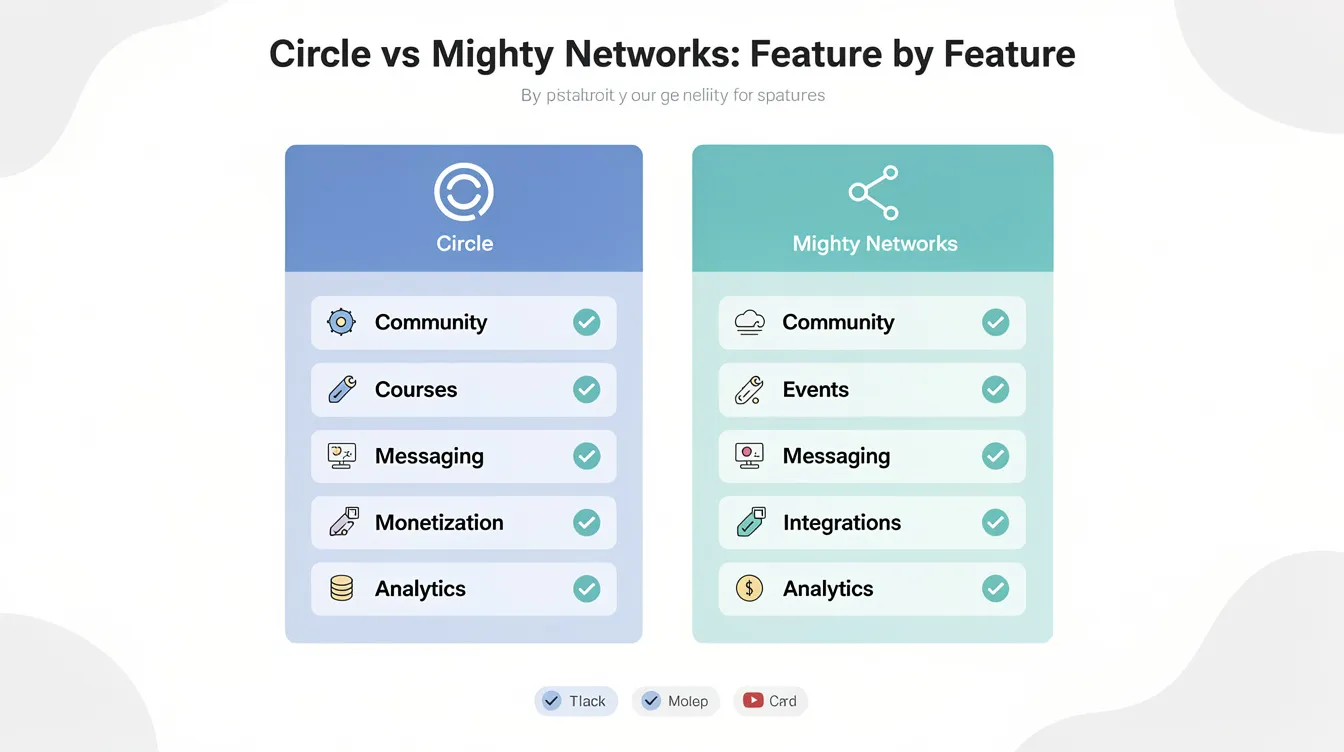
Round by Round: Feature-by-Feature Comparison
Ease of Use and Setup
Circle's interface is cleaner and more intuitive than Mighty Networks. It follows a workspace model—think organized Circle community spaces, threaded discussions, and simple navigation. Circle prioritizes simple navigation and organization in its design, and its community switcher tool lets you manage multiple communities without friction. Circle's interface is described as modern and user-friendly by most users testing both platforms in 2026.
Mighty Networks' interface has improved but still feels clunky compared to Circle's streamlined approach. Its dashboard packs many features into one view, which gives you power but adds complexity. For new admins, the learning curve is noticeably steeper. For community members, the feed-based layout can feel overwhelming if not carefully structured.
Edge: Circle for intuitive interface and faster setup.
Member Engagement and Community Building
Circle offers a comprehensive gamification system with activity scores. Members in Circle earn points for posting and attending events, and the platform provides engagement boosters including achievement badges for milestones. You can tag members, create member categories, and use leaderboards to display recognition for your most active members. Circle provides member tagging to enhance engagement and connections, making it a strong choice for community engagement focused on organized participation.
Mighty Networks emphasizes a social-network model for community interaction. It offers tools for member discovery and engagement—richer profiles, a member directory with features like "members near you," and multiple features within one space (feed, course, chat together). Mighty Networks facilitates stronger member-to-member connections through various tools, and its mobile app drives high daily community engagement. Mighty Networks integrates expanded member profiles into its platform, giving members more reasons to browse and interact.
Both platforms handle moderation, but Circle's workflow automation allows custom integrations without coding—bulk actions, conditional workflows, and multi-step logic that can trigger based on member behavior. Mighty Networks has basic gamification features like streaks and badges but lacks built-in automation features without Zapier.
Edge: Tie—Circle wins for structured engagement and automation; Mighty Networks wins for peer discovery and social dynamics.
Course Creation and Educational Content
Both platforms provide course functionality but differ in complexity.
Mighty Networks' course builder offers structured learning paths, certificates of completion, quizzes, and drip content—all tightly integrated with community and events in the same space. You can bundle multiple online courses into sequences and run cohort-based programs. Mighty Networks allows for a highly integrated ecosystem including courses and events, making it closer to an all-in-one platform for educational creators.
Circle features a more comprehensive course builder with drip scheduling and quizzes, and courses are included on all plans. However, Circle lacks multi-course learning path bundles and has more limited certificate functionality. For creators who want to create courses alongside community without paying extra, the Circle platform delivers solid basics. But if structured learning, credentialing, and course lessons organized into formal paths matter to you, Mighty Networks has a slight edge.
Edge: Mighty Networks for integrated learning experiences.
Pricing and Value Proposition
Circle's pricing starts at $89/month for the Basic plan—but specific pricing changes, so check the vendor's site for current rates. Circle charges a 4% transaction fee on its basic plan, which decreases on higher tiers. The professional plan has member limits, and the business plan unlocks advanced workflow automation, more spaces, and lower fees. Circle's higher plans enable custom CSS for further customization. As your community grows, the trade off is between base cost and transaction fees eating into revenue from paid communities.
Mighty Networks pricing follows a similar tiered approach. The community plan is the entry point but excludes courses. Mighty Networks charges a 3% transaction fee on the community plan. To access the Mighty Networks course builder and integrations, you need higher tiers. Mighty Networks requires the Scale plan for API access at $215/month, which is a significant jump. The scale plan unlocks API access and advanced features.
Neither platform offers a permanent free plan. Both charge transaction fees that accumulate as revenue grows—a friction point for creators scaling past several thousand dollars monthly.
Edge: Depends on community size and feature needs. Circle includes courses on all plans; Mighty Networks offers more unlimited members and spaces on some tiers but locks key features behind higher plans.
Integrations and Mobile Experience
Circle offers 15+ native integrations and a flexible API. Circle's Zapier integration supports 21 actions for automation, and you can connect third-party tools without coding through workflow templates—Circle provides 15+ pre-built workflow templates for automation. Circle's automation includes bulk actions for multiple members and conditional workflows. SSO, custom domain support, and webhooks make Circle strong for teams that rely on an external tool stack.
Mighty Networks' integrations are limited and locked behind higher plans. Its Admin API launched in beta in late 2025, and connecting to third-party tools often requires higher-tier access. Where Mighty Networks dominates is mobile: both Circle and Mighty Networks have mobile apps for iOS and Android, but Mighty Networks' mobile app allows full admin control from a phone, includes offline access, and supports branded mobile apps through Mighty Pro. Circle's app has reported lag during live sessions on mobile, and push notification support is weaker. Circle's mobile app supports in-app purchases for membership upgrades, but the overall mobile experience trails Mighty Networks.
Edge: Mighty Networks for mobile-first experience; Circle for integrations and automation.

Who Should Choose Circle
Key Reasons to Choose Circle
Choose Circle if you want a clean, professional workspace for building communities around discussions, content, and structured member engagement. Circle is designed for deep, streamlined member engagement and works well for SaaS customer communities, coaching groups, professional associations, and creators who value automation over social discovery.
Circle also fits you if you:
Need strong workflow automation and marketing features without relying on external tools
Want courses included on every plan without paying for a separate tier
Manage multiple communities and need a community switcher
Prioritize a polished, modern interface and organized community structure
Want a website builder and landing page builder with pre-made templates
Circle has over 2 million community members and 5,000+ creators on the platform in 2026.
Who Circle is NOT for
Who Circle is NOT for: Budget-conscious creators at early stages—the base cost and transaction fees add up. Communities that depend on mobile app engagement and push notifications. Anyone wanting extensive built-in gamification comparable to other platforms like Skool. If your live community depends heavily on Android apps and offline access, Circle will fall short.
Who Should Choose Mighty Networks
Key Reasons to Choose Mighty Networks
Choose Mighty Networks if you want a branded app experience, native livestreaming, and a platform designed to connect members through social discovery. The Mighty Networks community model suits fitness brands, coaching networks, membership organizations, and educational creators running events space and cohort programs.
Mighty Networks fits you if you:
Want a branded mobile app with full admin control and offline access
Run live events and livestreaming as core engagement tools
Need learning paths, certificates, and structured course sequences
Prioritize member-to-member networking with rich profiles and directories
Want each space to combine multiple features—feed, courses, chat—in one space
Who Mighty Networks is NOT for
Who Mighty Networks is NOT for: Users wanting simple, predictable pricing—the tiered structure with transaction fees and feature lockouts creates friction. Anyone prioritizing ease of use and fast onboarding. Communities focused primarily on text discussions and threaded content. If you need robust third-party integrations and API access without paying for an enterprise plan or scale plan, Mighty Networks will frustrate you.
Final Verdict: Choose Based on Your Community Profile
The healthy competition between these two platforms means both have improved dramatically. But they serve different visions for community building.
Choose Circle if your community centers on professional discussions, content organization, workflow automation, and you work primarily from desktop. You want a clean interface, strong integrations, and courses included without paying for separate tiers.
Choose Mighty Networks if your members live on their phones, your brand needs a custom mobile app, and your model revolves around live events, networking, and structured learning paths with certificates.
Both Circle and Mighty Networks will continue shipping features—Circle toward richer course credentialing and AI workflows, Mighty Networks toward stronger automations and developer tools. But the architectural difference—workspace versus social network—is fundamental and unlikely to converge.
Start with a free trial on each. Build a test space, invite a few members, and see which experience matches how your community actually behaves—not how you imagine it should.
Frequently asked questions
Neither is universally better. Circle excels at organized discussions, automation, and professional community tools. Mighty Networks is stronger for mobile apps, live events, and peer networking. The best choice in 2026 depends on whether your community needs structured workflows or social discovery and branded app experiences.
Both platforms use tiered pricing with transaction fees. Mighty Networks' entry community plan costs less but excludes courses. Circle includes courses on all plans but starts at a higher base price. Check each vendor's site for current rates—costs shift as your community grows and you need features locked behind higher tiers.
Mighty Networks offers deeper course tools: learning paths, certificates, and tightly integrated course-community spaces. Circle features a solid course builder with drip scheduling and quizzes on every plan. If structured learning and credentialing are priorities, Mighty Networks has the advantage. If you want courses alongside community without upgrading, Circle delivers.
It depends on engagement style. Circle offers gamification with activity scores, leaderboards, and automated workflows to nudge active members. Mighty Networks drives peer-to-peer engagement through rich profiles, member discovery, and a social feed model. In 2026, Circle suits structured engagement while Mighty Networks suits organic, social interaction.
Yes. Circle offers a migration team to help transfer content, member data, and course structure. Typical migration takes two to four weeks. Plan for potential disruption—preview everything before going live and communicate clearly with community members to minimize churn during the transition.