

Skool is a community platform built around gamified engagement and course delivery. Kajabi is an all-in-one platform that bundles online courses, email marketing, sales funnels, and website building into one connected system. Neither is universally better - the difference between Skool and Kajabi comes down to whether you need community-led learning or a complete course business infrastructure.
If community interaction drives your teaching style and you want a simple, affordable setup, Skool is the stronger pick. If you need built in marketing tools, automated sequences, and a full fledged course website without stitching together separate tools, Kajabi is the better fit.
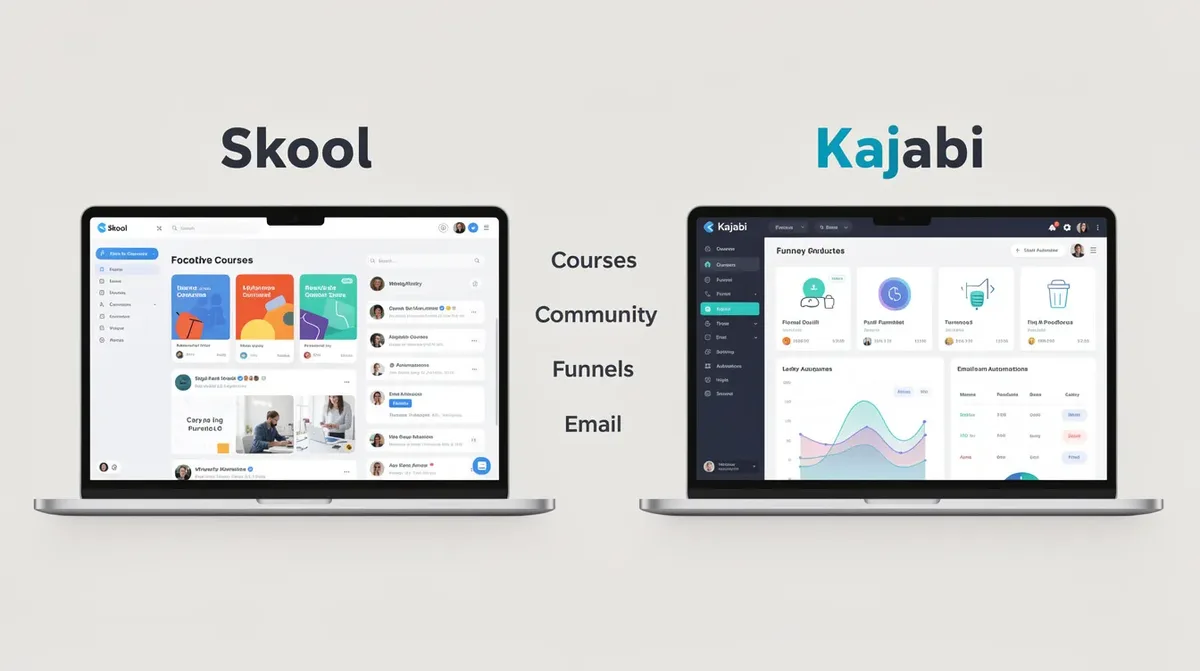
Quick verdict: who each platform serves best
Skool is a community-first course platform. It treats community as the container - courses, discussions, and gamification all live inside the skool group. Members earn points, climb leaderboards, and unlock course content through engagement rather than calendar dates. It's built for creators who believe community building is the engine of retention.
Kajabi operates as a complete sales ecosystem. It consolidates online courses, email marketing, sales funnels, landing pages, membership sites, coaching programs, and even branded mobile apps into one system. Kajabi serves as an all-in-one marketing platform where courses are one product type among many.
Skool excels for creators prioritizing gamified community engagement over complex tools. Kajabi suits entrepreneurs building full-scale course businesses with funnels, marketing automation, and multiple product lines. Your decision hinges on whether you're building around a community or around a marketing engine.
Skool vs Kajabi at a glance
Skool | Kajabi | |
|---|---|---|
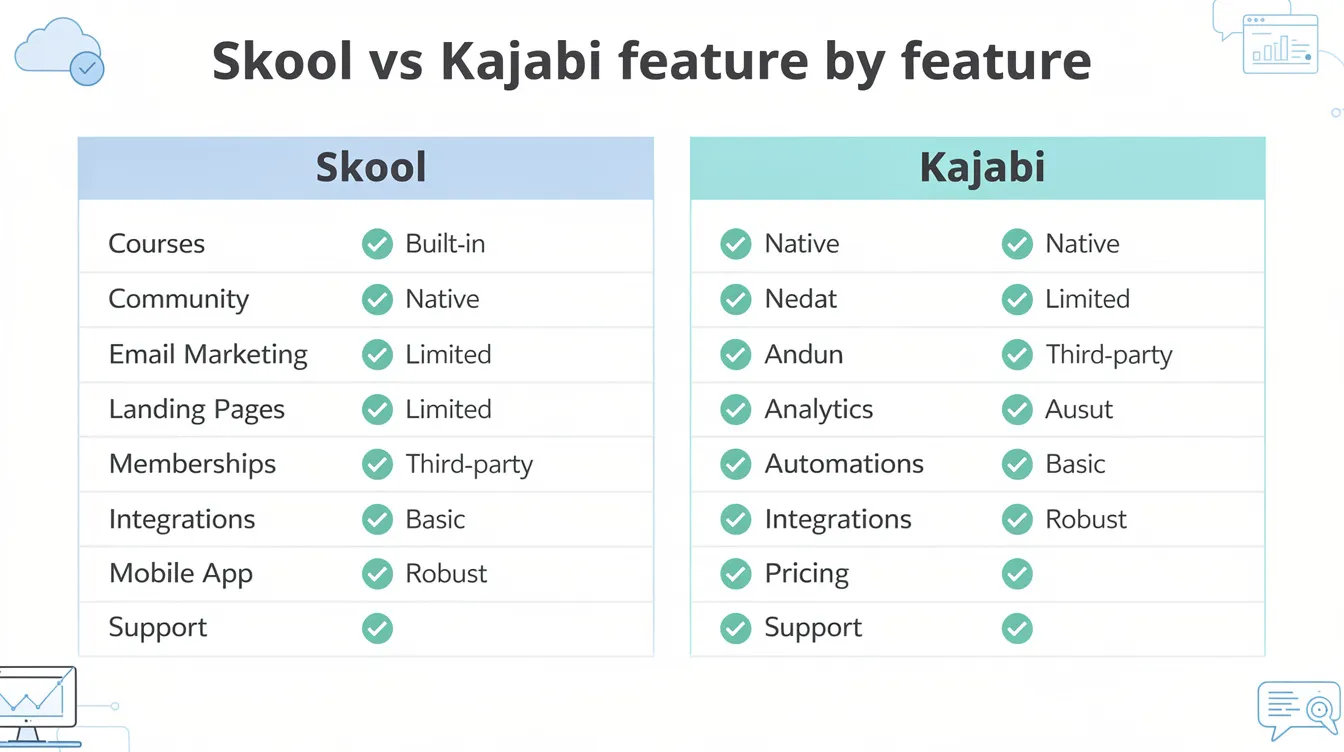
Best for | Community-led learning, group coaching programs, gamified engagement | Full course business with marketing, funnels, and automation |
Ease of use | Very simple - four main tabs, minimal setup | More complex - multiple dashboards, steeper learning curve |
Key features | Community feed, classroom, leaderboards, points, live events, native video hosting | Course builder, email marketing system, funnel builder, landing page builder, community spaces, branded app |
Pricing model | Flat monthly fee + transaction fees on lower plan | Tiered monthly plans based on products and contacts (check vendor's site for current pricing) |
Free trial | 14-day free trial | 14–30 day free trial |
Mobile app | Member mobile app access | Member app + branded mobile app on higher tiers |
What makes it unique | Community is the product; gamification is baked in, not bolted on | Replaces multiple tools with one connected system |
Unlike Kajabi, Skool keeps everything intentionally stripped down. Unlike Skool, Kajabi gives you a complex funnel machine and marketing automation under one roof.
Round by round: detailed feature comparison
Ease of use and setup
Skool is simpler and offers a user-friendly interface built around four tabs: Community, Classroom, Calendar, and Members. You can go from signup to a live skool community with course content in under an hour. There are fewer decisions to make because there are fewer features to configure.
Kajabi's dashboard is more complex. You're managing products, pipelines, community spaces, automations, websites, and landing pages across multiple sections. Kajabi's course builder includes a drag-and-drop interface that's polished, but first-time creators often feel overwhelmed by the feature mass. That said, experienced creators appreciate having everything already in place as they scale.
If you're creating courses for the first time and want to launch fast, Skool's learning environment gets you there faster. If you're willing to invest setup time in exchange for long-term power, Kajabi rewards that patience.
Edge: Skool for simplicity, Kajabi for power users.
Community engagement and gamification
Skool's community is designed for high engagement and interaction. Gamification isn't an add-on - it's structural. Skool offers gamification with points and leaderboards baked directly into the experience. Members earn points for community posts, completing lessons, and participating in discussions. Skool allows content locking based on user levels for engagement, meaning course access can be gated by participation rather than payment tiers alone. This approach to community skool architecture tends to produce high daily active usage in smaller, creator-led groups.
Kajabi's community features were added later, affecting engagement depth compared to purpose-built community platforms. That said, Kajabi has improved substantially through 2025–2026: it now includes leaderboards, badges, titles, challenges, customizable channels, and live events. Kajabi provides a Live Room for virtual meetings directly within the platform. The kajabi community experience is functional and growing, but community isn't the central axis - it sits alongside courses and marketing rather than wrapping around them.
Research suggests courses with integrated community discussion see completion rates around 65% compared to roughly 43% without - a dynamic that favors Skool's architecture where community and course content are inseparable.
Edge: Skool for engagement-driven communities.
Course creation and delivery
Skool's course builder handles basic modules, video uploads, text content, and file attachments structured into modules and lessons. You can create unlimited courses and upload videos with native video hosting and student progress tracking included. Skool's courses integrate with community features for engagement, which is its strength. However, Skool's course builder lacks automation tools - there are no quizzes, no certificates, no SCORM compliance, and no calendar-based drip content. If you need formal assessments for a coaching program or continuing education, Skool can't deliver that natively.
Kajabi supports multiple product types within its platform: evergreen courses, cohort-based programs, memberships, and coaching. Kajabi offers advanced course features like quizzes and certificates, plus drip content scheduling, live rooms, and modular curricula. Kajabi provides advanced learning features like assessments and drip content that make it suitable for professional training environments. Kajabi supports up to 100 products and 20,000 students on higher plans, while Skool allows unlimited courses for its flat rate.
For Skool vs Kajabi for courses, the answer depends on complexity. If you're creating courses with basic video modules and community discussion, Skool handles it well. If you need structured assessments, certificates, and scheduled drip content, Kajabi is the stronger online course platform.
Edge: Kajabi for comprehensive course features.
Pricing and value proposition
Skool is typically less expensive for community-focused solutions. Skool offers a hobby plan at a low monthly price point with a 10% transaction fee per sale, and a Pro plan at a higher monthly rate that drops transaction fees significantly. Skool's Pro plan includes unlimited courses and members with no hidden fees. The break-even between the two Skool plans occurs when monthly revenue reaches roughly the mid-four-figure range where fee savings outweigh the higher subscription.
Kajabi is more expensive than Skool. Kajabi's tiered pricing scales with the number of products, contacts, and features you need - its basic plan starts at a higher monthly commitment than Skool's top tier. Kajabi charges no platform transaction fees on sales, though standard payment processor fees still apply. For current Skool vs Kajabi pricing, check each vendor's site as both have adjusted rates in 2026.
The real pricing question isn't subscription cost alone - it's total cost of ownership. With Skool, you'll likely need a separate marketing stack: an email marketing system, a landing page builder, opt in forms, and possibly a funnel building tool. Those separate tools add up. Kajabi consolidates various offerings more effectively than Skool, potentially saving money if you'd otherwise be paying for five or six services.
Edge: depends on your feature needs and scale.
Marketing tools and integrations
Skool has no built-in sales funnels or checkout options. Skool lacks native email marketing and requires third-party tools for automated sequences, conversion optimized checkout pages, and funnel building. Skool's marketing relies on community engagement and referrals plus a Discovery listing that helps new members find skool communities. Skool provides webhooks for limited integrations, but Skool lacks native integrations - community managers who need a robust marketing stack will be assembling it from multiple tools.
Kajabi includes marketing automations and sales funnels as core features. Kajabi enables high-level marketing through complex automated email sequences. Kajabi includes a visual funnel builder for sales processes and allows for upsells and order bumps in its checkout process. Kajabi provides professional branding and customization tools including a website builder, landing pages, and a branded mobile app on higher tiers. Kajabi offers integrations with 16 third-party apps - Kajabi's integrations include Zapier and MailChimp, and they're easier to set up than Skool's webhooks.
Kajabi offers built-in email marketing and automation tools that eliminate the need for a separate email marketing platform entirely. If you want to sell online courses without cobbling together separate tools, Kajabi is the all in one solution.
Edge: Kajabi for all-in-one marketing needs.
Who should choose Skool
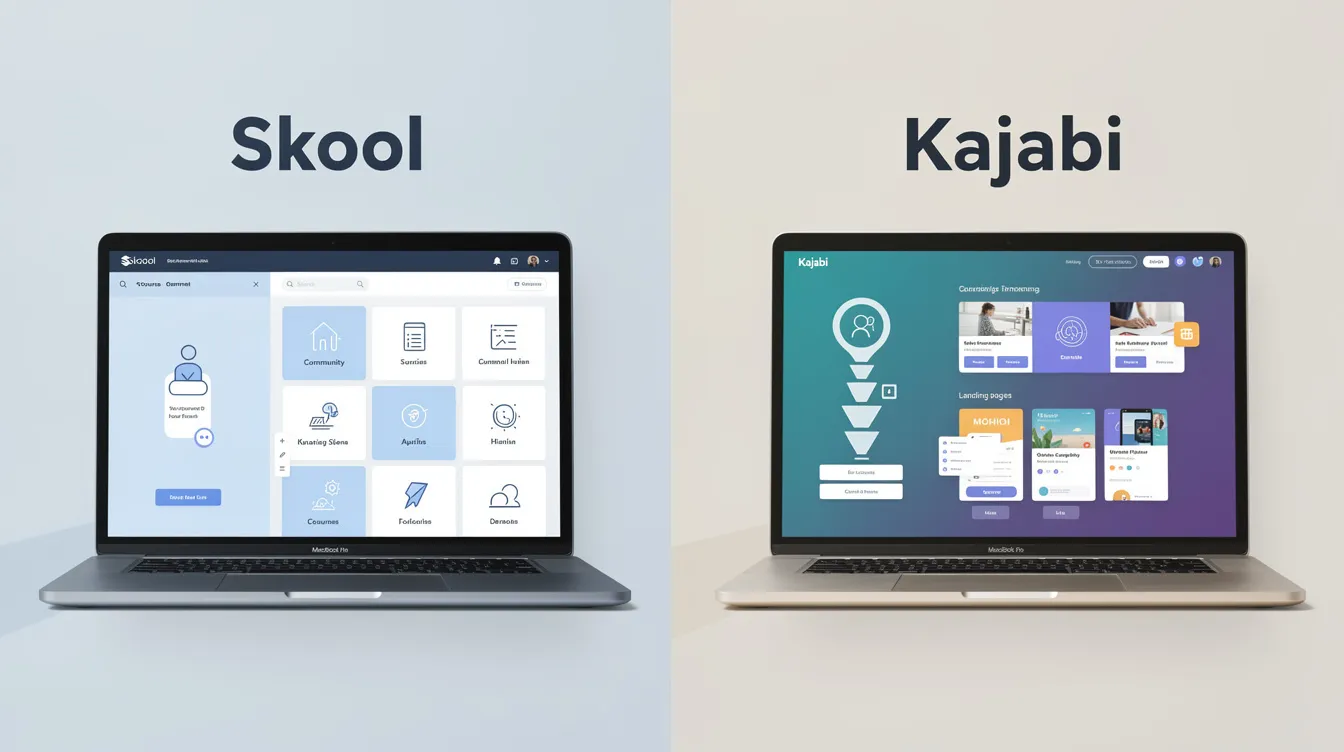
Choose Skool if you're a course creator who believes community interaction drives student outcomes. It's the best online course platform for educators who want a simple, distraction-free learning environment where members engage daily through community posts, earn points, and progress through gamified levels.
Skool works well for creators already using WordPress and separate email marketing tools who just need a community platform and course delivery layer. It's ideal for group coaching programs, paid communities, and membership-based education where the creator is actively present.
Who Skool is NOT for: Creators needing deep design customization, a fully branded mobile app, certificates, formal assessments, or comprehensive built-in marketing. If you need advanced features like automated email sequences, sales funnels, or landing pages without relying on third party tools, Skool will frustrate you. It's also not the right fit if you're scaling a large course business with multiple product lines and thousands of contacts requiring marketing automation.
Who should choose Kajabi
Choose Kajabi if you're building a full course business that needs marketing, sales, and delivery in one system. It's ideal for entrepreneurs selling multiple online courses, memberships, and coaching programs who want to own marketing end to end - from opt in forms to automated sequences to checkout.
Kajabi suits creators wanting an all in one platform that replaces a website builder, email marketing system, funnel builder, and course platform simultaneously. If you need conversion optimized checkout pages, upsells, drip content, and professional branding under one roof, Kajabi delivers.
Who Kajabi is NOT for: Simple community builders who only need a discussion space and basic course hosting. Creators on tight budgets who don't need - and won't use - the full marketing stack. If you're launching a single paid community or a straightforward coaching program, kajabi pricing may feel excessive for features you'll never touch. The complexity of the platform can also overwhelm creators who prefer minimal, focused tools.
Final verdict: choosing by creator profile
Community-focused creators should choose Skool. If your course business runs on community-led learning - where members engage daily, climb leaderboards, and retention comes from social connection - Skool's architecture is purpose-built for that model. It's affordable, fast to set up, and keeps community interaction at the center of everything.
Business-focused creators should choose Kajabi. If you're building a course business with multiple products, marketing funnels, email automation, and branded experiences, Kajabi gives you one system instead of six. It replaces the need for a separate email marketing platform, website builder, funnel builder, and course creation platform.
Factor in total cost of ownership: Skool's subscription is lower, but add the cost of separate tools for email, funnels, and landing pages. Kajabi's subscription is higher, but you may not need anything else.
The strongest recommendation: test both. Both platforms offer free trial periods in 2026. Build a small pilot in each - upload a course, invite a few members, try the community tools. The platform that matches how you actually teach and sell is the one you should keep.