

Skool is a gamified community platform built for course creators who want simplicity. Mighty Networks is a feature rich platform designed for branded mobile experiences and structured learning. Neither is universally better - the difference between Skool and Mighty Networks comes down to whether you prioritize engagement loops or deep customization.
This guide is for course creators, coaches, consultants, and organizations comparing Skool and Mighty Networks for building online communities.
After testing both platforms in 2026, here's the quick verdict: choose Skool if you want built in gamification, flat pricing, and a community that feels alive from day one. Choose Mighty Networks if you need a branded mobile app, complex course delivery with certificates, or multiple spaces for larger communities.
Both platforms serve different community building philosophies. Skool keeps things deliberately simple - community feed, classroom, events calendar, leaderboard - all enabled by default. Mighty Networks offers more control over branding, content delivery, membership tiers, and native mobile experiences, but that flexibility means more decisions upfront. Both platforms serve different community building philosophies: Skool focuses on simplicity and engagement, while Mighty Networks emphasizes customization and structure.
This comparison breaks down exactly where each platform works best so you can pick the right platform for your specific situation.
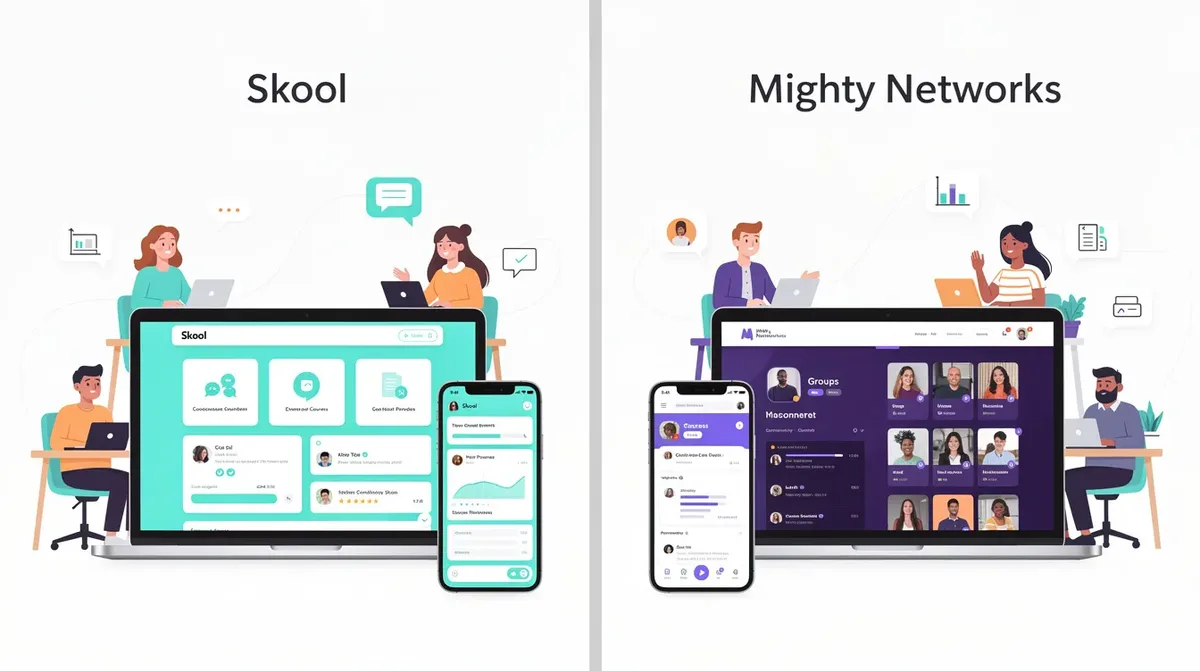
Skool vs Mighty Networks: Key Differences
Skool is an all-in-one community platform combining online courses, live events, and gamification features in a single streamlined interface. It places community first - the feed, points system, and leaderboard drive daily member engagement - while courses and event hosting support that core loop.
Mighty Networks is a broader membership site and course platform that gives creators extensive customization and branding options. Community is central but sits within a richer ecosystem of Spaces (specialized areas within Mighty Networks for segmenting communities, see Fact: "Mighty Networks supports complex community segmentation with Spaces."), structured learning paths, native video hosting, and native live streaming capabilities.
The main distinction is simplicity vs customization. Skool chooses opinionated simplicity with fewer settings to configure. Mighty Networks trades higher complexity for more depth - tiered plans, feature gates, branded apps, and stronger content creation tools. Both can power paid communities with courses attached. Which works better depends on your audience size, content complexity, branding priorities, and budget.
At a Glance: Side-by-Side Comparison
Aspect | Skool | Mighty Networks |
|---|---|---|
Best for | Solo creators, coaches, small paid communities wanting engagement and simplicity | Mid-to-large creators and organizations needing branded experiences and structured courses |
Ease of Use | Very fast setup - clean web interface, minimal configuration, many users live in under an hour | More learning curve - multiple settings, Spaces structure, membership tiers, mobile app configuration |
Standout Features | Built in gamification (points, levels, leaderboard), community feed + classroom + events calendar | Drip content, quizzes, certifications, native iOS and Android apps, flexible community spaces |
Pricing Model | Flat monthly fee with all features included from day one; check vendor's site for current pricing | Tiered pricing starting lower but adding transaction fees; advanced features gated behind higher plans |
Free Trial | 14-day free trial; no free tier for creators | 14-day free trial on paid plans; community-only plan available at lower cost |
Mobile App | Standard Skool mobile app (iOS & Android) mirroring web simplicity | Full native apps; branded mobile app available on higher plans via Mighty Pro |
Round by Round Comparison
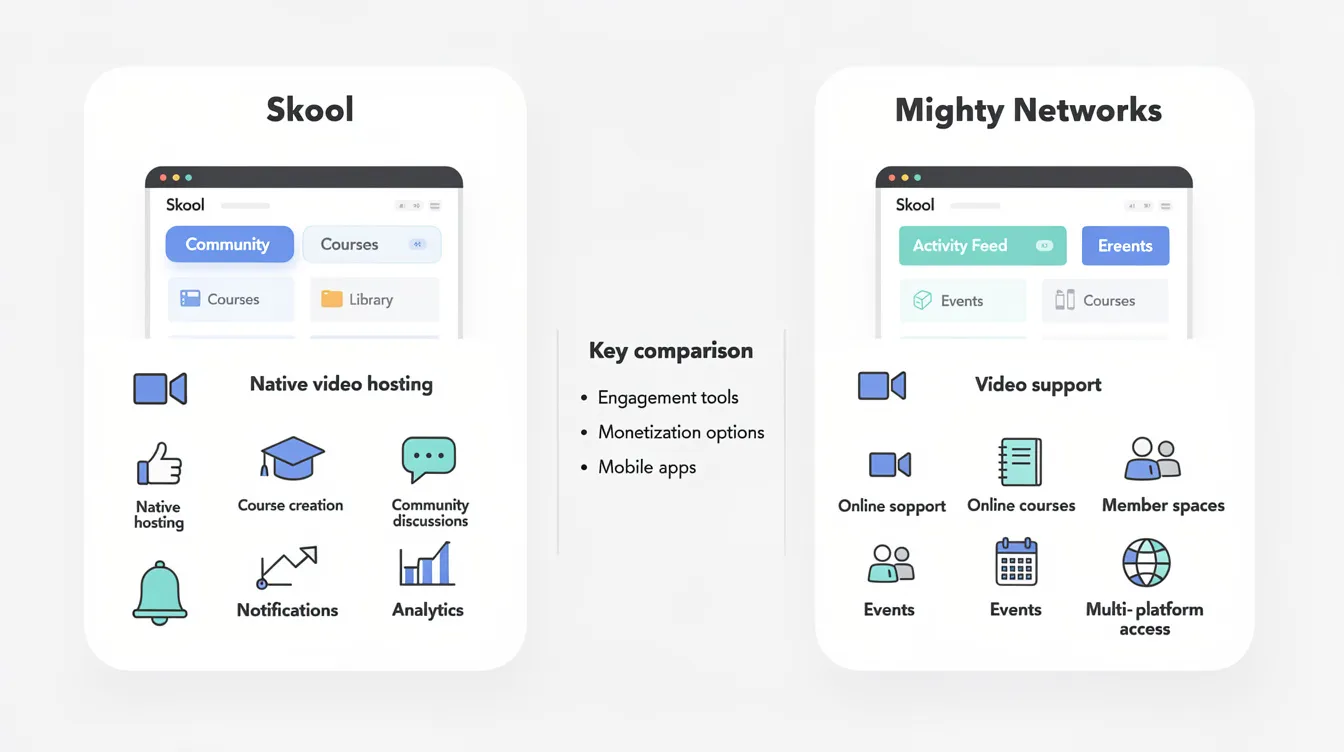
Ease of Use and Setup
Skool encourages fast onboarding for both admins and members. The essential components - community feed, classroom, events calendar, leaderboard - are built in and enabled by default. There's no menu of toggles to configure, no feature tiers to evaluate. Many users report going live within an hour without technical support.
Mighty Networks may have a steeper learning curve due to its complexity. Setting up Spaces, designing membership plans, configuring release schedules, and building a branded mobile app all require decisions. That means more flexibility, but also more friction. Some features like white label apps may require longer lead times or developer involvement.
Skool is better for educators looking for simplicity over advanced customization. If you want a new platform running by this afternoon, the Skool platform gets you there faster.
Edge: Skool
Member Engagement and Community Features
Skool is designed to feel like a game for engagement. Members earn points for posts and comments in Skool, progress through levels 1–9, and compete on a visible leaderboard for community engagement. Skool's gamification includes a points system for community moderation, and members can unlock rewards through gamification - including gated content or privileges. Skool features a leaderboard that keeps community members engaged and active daily. Skool has a single feed with categorized topics, keeping discussions focused.
Mighty Networks focuses on connecting members through specialized Spaces. Unlike Skool, it offers multiple channels for community discussions, allowing creators to segment by topic, member role, or access level. Mighty Networks allows for event management and RSVP tracking, and supports interactive elements like challenges, polls, and resource libraries. Mighty Networks has basic gamification like streaks and milestones, but it's less central to the experience than Skool's approach. Both platforms support direct messaging between members.
The two platforms drive different types of engagement. Skool wins if you want competition-driven activity that keeps members engaged through visible progress. Choose Mighty Networks if you want broader community features across multiple spaces with varied content types.
Edge: Tie - Skool for gamification-driven communities, Mighty Networks for diverse engagement across community spaces.
Course Creation and Delivery
Skool's classroom integrates directly with its community feed. You can build course modules with video, text, and file attachments. Skool allows drip content but lacks structured course features like sophisticated assessments or timed sequential unlocking. Skool does not provide advanced learning tools like quizzes. Course gating by membership tier or by gamification level is available, but if you need to sell courses with certificates or run challenges tied to assessments, Skool's course creation tools won't cover it.
Mighty Networks offers a significantly deeper course platform. It supports native video hosting for courses, drip and scheduled release, sequential unlocking, and self paced courses alongside structured learning paths. Mighty Networks offers quizzes and tests for course engagement, and enables multi-step learning paths with certificates. Automations handle celebration and re-engagement when someone stalls. For any course creator building standalone courses or structured curricula, Mighty Networks offers best in class delivery tools compared to Skool.
When you compare mighty networks and Skool on Skool vs Mighty Networks for courses, the gap is clear. Mighty Networks gives you more control over content delivery and progress tracking.
Edge: Mighty Networks
Pricing and Value
Skool charges a flat $99/month with no tiers. Skool's pricing includes all features from day one - unlimited members, unlimited courses, live events, gamification features, affiliate tools. Skool has no transaction fees for sales under a certain threshold, using standard payment processing after that. The business model is straightforward: one price, everything included.
Mighty Networks offers tiered pricing with more advanced features unlocked at higher levels. Mighty Networks' plans start at $79/month with transaction fees - for example, Mighty Networks charges a 2% transaction fee on its Launch plan, decreasing at higher tiers. Features like branded apps, advanced integrations, SSO, and custom branding require upgrading. Mighty Pro offers custom pricing for organizations wanting fully white label apps and enterprise-level support.
Value depends entirely on your revenue scale and which features matter. If you're running a simple paid community and want cost predictability, Skool's flat rate is hard to beat. If you need certificates, a branded mobile app, or multiple membership tiers, you'll need Mighty Networks' higher plans - and the cost adds up. Check each vendor's site for current 2026 pricing, as both platforms adjust their plans.
Edge: Depends on your needs - Skool for predictable cost, Mighty Networks if you need what the higher tiers unlock.
Mobile Experience and Integrations
Skool's mobile app mirrors the web version's simplicity - community feed, classroom, events calendar, leaderboard all accessible on iOS and Android apps. Skool's mobile app allows recording and uploading videos directly. However, some users report app stability issues, navigation friction on certain devices, and limited search capabilities in larger communities.
Mighty Networks offers native iOS and Android apps for all members, with over 65% of engagement reportedly happening on mobile. Mighty Networks' apps include mobile live streaming capabilities and push notifications. On higher plans, Mighty Networks offers custom branded apps - your own icon, name, colors, and splash screen through Mighty Pro.
On integrations, Skool is more limited. Basic Stripe payment and affiliate tools are built in, but deep automation, email tools, or SSO aren't native - you'll need external tools or Zapier. Mighty Networks supports more native integrations at higher tiers: email and newsletter tools, SSO, branded domains, and embedding third-party tools. The platform supports a wider range of connections as you scale.
Edge: Mighty Networks
Who Should Choose Skool
Skool is ideal for course creators, coaches, and consultants who want to launch a paid community quickly with minimal technical overhead. If your content consists of video, PDFs, and simple lesson material - not dependent on quizzes, certifications, or advanced assessments - the Skool community structure gives you everything you need.
Communities focused on accountability, group interaction, and daily engagement benefit most from Skool's gamification. Fitness groups, masterminds, and small coaching communities thrive when members can see their progress on a leaderboard and compete with other users. Skool is ideal for small to medium-sized groups where that competitive energy translates directly to retention.
Creators who value straightforward pricing - no feature tiers, no surprise transaction fees at lower revenue levels, no optional add-ons - will appreciate Skool's flat model. And if you've been running Facebook Groups and want a dedicated community builder without the noise, Skool feels like a natural upgrade.
Who it's NOT for: If you need deep customization in layout and design, want to sell courses with certificates and quizzes, require a branded mobile app under your own name, or need advanced automation and white label apps, Skool will feel limiting. Larger communities needing complex segmentation or enterprise-level reporting should look elsewhere.
Who Should Choose Mighty Networks
Choose Mighty Networks if you're building a branded community experience - especially one where a custom mobile app, your own domain, and visual identity matter. Mighty Networks is designed for organizations managing multiple communities and supports complex community segmentation with Spaces, making it strong for professional development communities, academies, and creator businesses with diverse audiences.
Mighty Networks is better suited for professional development communities that need structured curricula. If passing assessments or awarding recognized completion credentials is part of your business model, the platform delivers. Mighty Networks is favored for providing more robust features as communities grow - drip content, native live streaming, event hosting with RSVP tracking, and deeper analytics all scale with you.
The bottom line: Mighty Networks offers the depth you need when a simple community feed and leaderboard aren't enough. If you want to create multiple Spaces, run challenges with built-in assessments, and deliver a polished mobile-first experience, this is the more capable platform.
Who it's NOT for: If you want extreme simplicity, minimal setup, or have a tight budget with a smaller membership base, Mighty Networks may feel like overkill. The tiered pricing and configuration complexity aren't worth it if you just need a straightforward course plus community that launches fast.
The Verdict: Choose Based on Your Profile
The core difference between Skool and Mighty Networks hasn't changed in 2026: Skool delivers gamified simplicity, Mighty Networks delivers branded flexibility. One emphasizes engagement loops and speed. The other emphasizes structure, branding, and course infrastructure.
Choose Skool if you're a creator seeking to launch quickly, build a paid community with strong daily activity via gamification, and avoid technical overhead. The Skool platform works best when your content is straightforward and your community thrives on visible competition and accountability.
Choose Mighty Networks if you're an organization or scaled creator needing structured curricula, a custom branded mobile app, advanced course features, multiple spaces, and deeper control over member experience. Mighty Networks allows extensive customization and branding that Skool simply doesn't offer.
Both platforms offer 14-day free trials. Use that time to test the mobile app experience, upload sample course modules, and invite a handful of community members to see which platform works for the way you actually operate. There's no universal winner between Skool or Mighty Networks - only the right platform for your specific community goals, content complexity, and growth plans.